| View previous topic :: View next topic |
| Author |
Message |
Thomas Southern
Junior Member
Joined: 25 Oct 2008
Posts: 12
Location: Fletcher, NC USA
|
 Posted: Wed Jul 29, 2009 3:57 pm Post subject: Restoration project Posted: Wed Jul 29, 2009 3:57 pm Post subject: Restoration project |
 |
|
Hi Everyone,
I have a full size violin I purchased to learn to restore violins. The violin was in pretty rough shape. It had numerous grafitti items scratched and ink pened in the top plate and back. Other things wrong with it were: A bass wing crack, a crack that ran from the trebel f hole down through the bottom. The neck block was loose, the tail pin block was loose, linings and sides were loose in in a few places. The neck was loose and had been reglued with PVA ,along with the finger board. I understand that one usually doesnt strip the varnish off of restorations, but since it was in a vandalized condition not just a petina from use I decided to strip it. On the back there were initials scratch through the finish to bare wood that had been filled in with ink pen. I repaired the top plate using hide glue and cleats on the large and just hide glue on the wing crack. It took three tries to glue the big crack. I had to build a clamping jig and purchase an edge clamp to get the job done properly. The back plate I had to sand the pen ink off therefore I ended up removing the ground. I understand sandpaper is taboo but I still need to purchase scrapers. The scroll also had a place that needed to be sanded.
A few questions I have are:
-How do I get the flaming on the back and neck, where I sanded, to darken prior to finishing. I tried to hang them in a window for several weeks and they darkened slightly but not enough. I think I read somewhere that you can fume them with some chemical vapors to darken them.
-From the pictures can you tell what I should try to use as a ground to blend with the sanded spots on the top plate?
-Should I cleat the wing crack?
-My cleats are about 1.4mm thick and taper towards the edges , should the be thinner?
-Do you have any idea or the age of the violin? There were two labels inside one on top of the other. They say "Made in Germany" this might be a clue since when the country was divided the it would state "Made in West Germany"
-From tooling marks in the top and bottom plate you can tell this violin was graduated with a machne. Should I consider regraduating the top plate? I'm still new at this and I"m thinking no.
Thanks
Tom
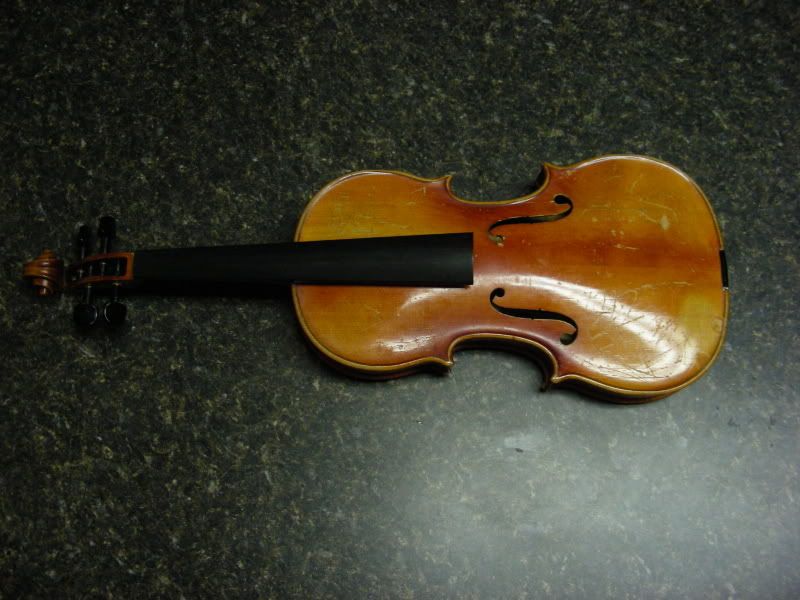


 |
|
| Back to top |
|
 |
Mat Roop
Senior Member
Joined: 24 Mar 2007
Posts: 911
Location: Wyoming Ontario
|
| Posted: Thu Jul 30, 2009 9:43 pm Post subject: |
|
|
Tom... you have a great learning opportunity!
I would not worry about darkening the flaming... I would make a point of scraping lightly, even though you have sanded. Scraping leaves the flaming much more accentuated. If you don't have a scraper... make one from any tempered thin steel such as a hacksaw or snapped bandsaw blade.. you can make a good scraper from the blade of a BBQ patty spatula. I have a nice scraper that was originallt for scraping the bottom of skis. There should be lots of hits if you google " make burnish scraper" eg... http://www.inthewoodshop.org/methods/wwc07.shtml
In time the freshly exposed wood will develop its patina again.
What you use for ground or varnish could be debated for eons... search this site as there is lots of discussions on the matter... pick one & go for it. Esiest for me is orange shellac ground and commercial violin oil varnish.
I don't usually cleat cracks on violins (waitng for a Blast! ) because the center seam is glued and that stands up to centuries of use... and there never seems to be any one to dispute that a good hide glue seam is stronger than the wood itself... so why cleat??? I cleat in cases of severe damage where the mating surfaces are less than great. If you do cleat... keep them slim and small and angle the grain about 10 degr. off the grain of the plate... Not perpendicular!
To glue a crack on an opened violin you don't need special tools... But a zipper cleat method is essential.
Age? My guess is pre wwII
I would check all dimensions... If they are off, for sure regraduate what is necessary to get the best balance of what exists. Some areas might be thinner than spec and so you will need to get a feel of what needs to be thicker to compensate. Check all dimensions and work to get them all as close to ideal as possible including neck angle, overstand and stop ratio.
I am sure there will those who have other opinions... but these are my humble ones!... and glad to help! Good luck! Mat |
|
| Back to top |
|
|
John Cadd
Super Member
Joined: 23 Jul 2009
Posts: 1344
Location: Hoylake
|
| Posted: Sat Aug 22, 2009 7:49 pm Post subject: Restoration project |
|
|
For fixing cracks I believe the best way these days is to use VELUM which is what a banjo"belly" is made from.Some violins are covered in them(inside) but the weight is so small the sound is still good.Small neat round patches is the way to go.You may find a site telling the full story .Strad magazine had an article about this.
I saw a train film from America once with a hill billy fiddle player and the belly had a gaping crack right down from the soundhole 1/4 inch wide open.Sounded great! |
|
| Back to top |
|
|
FiddleDoug
Member
Joined: 08 Sep 2007
Posts: 227
Location: Hilton, NY
|
| Posted: Thu Sep 10, 2009 9:56 pm Post subject: |
|
|
The Weissharr & Shipman book warns against using parchment/vellum for cleating cracks. The edges have a tendency to come loose and buzz. The cleats that you have in there could use a little thinning and trimming. What varnish are you planning to use on this?
_________________
Doug Wall
www.wallindependent.com |
|
| Back to top |
|
|
Thomas Southern
Junior Member
Joined: 25 Oct 2008
Posts: 12
Location: Fletcher, NC USA
|
| Posted: Fri Sep 11, 2009 11:35 am Post subject: |
|
|
| Doug I'm not sure what varnish I will be using. I havn't made any progress on the project since work is getting in the way. How thin should the cleats be ? |
|
| Back to top |
|
|
|

 FAQ
FAQ Search
 Memberlist
 Usergroups
 Register
 Profile
 Log in to check your private messages
 Log in


